

I Scored 9 Peptide Sellers on 6 Trust Signals. The Gap Between #1 and Everyone Else Wasn’t Close.

Last updated: June 2026. Most of what’s discussed here is prescription or compounded, and several compounds are not FDA-approved for the uses men over 40 go looking for them. Every claim links back to something you can read yourself.
Here’s the promise you’ve probably heard, in one form or another, from a gym buddy or a corner of the internet: there’s a peptide out there that will bring back your 30-year-old joints, your 30-year-old testosterone, maybe your 30-year-old everything. And here’s the reality, which I went looking for with a spreadsheet instead of a hunch: some of that is real, most of it is thinner than advertised, and almost none of it tells you the one thing that actually predicts whether you’re safe, which is who’s on the other end of the transaction.
So I did what I do with any claim that matters this much. I stopped asking “does it work” as the only question and started asking “can I trust the source telling me it works.” I picked six signals that actually predict harm, gave nine peptide sellers a score out of 30, and let the numbers sit there instead of dressing them up.
The headline: the physician-supervised, pharmacy-dispensing model scored 27 out of 30. Every research-chemical seller in my sample scored between 3 and 6. That’s not a close race. And the 2026 regulatory shakeup made the gap wider, not narrower.
First, what actually happened in 2026 (because it’s not what the headlines said)
You’ve probably seen this called a “ban.” It wasn’t, and getting that detail wrong will send you to the wrong conclusion.
In April 2026 the FDA pulled BPC-157 and eleven other peptides off its Category 2 “do not compound” list after the nominations to keep them there were withdrawn, and it scheduled a Pharmacy Compounding Advisory Committee meeting for July 23-24, 2026 to decide whether several of these belong on the approved list of compoundable substances [8]. Read that again slowly, the way I had to. Coming off a do-not-compound list is not the same thing as getting approved. It means a compound moved into the waiting room, not that it got cleared by the doctor.
If a seller tells you BPC-157 is now “legal and proven,” they’ve either misread the regulatory record or they’re hoping you won’t check. Either way, that’s useful information about them, not about the peptide.
What the broader crackdown really did was sharpen a line that already existed, between sellers working inside a medical and pharmacy framework and sellers working behind a “research use only” sticker. That line turned out to be the single best predictor of everything else I measured, which is why it sits at the center of my scorecard.
The six things I actually checked, and why
I gave each source 0 to 5 points on six signals, for 30 possible points. I didn’t rig the weighting. I picked the questions a research-chemical seller structurally cannot answer well, because those are the questions that matter.
Is a licensed clinician actually evaluating you before anything ships, or does the transaction stop at a checkbox that says “I confirm I’m over 18”?
Is a licensed pharmacy compounding and dispensing the product, or is it self-shipped from a supplier nobody is accountable to?
What actually arrives in the box , an FDA-reviewed drug, a pharmacy-compounded preparation, or a powder whose contents rest entirely on the seller’s word?
Does the source tell you the truth about the evidence, including the unflattering parts, or does it lean into implied benefits the data doesn’t support?
Does the operation sit inside licensed telehealth and legitimate compounding, or does it use a “research use” label to dodge the whole medical framework?
Is anyone checking in on you after the first order, the way testosterone and most of these compounds genuinely require, or does the relationship end when the tracking number arrives?
I want you to notice what’s missing from that list: price, shipping speed, how big the catalog is. Those are the things a typical “best peptides” roundup optimizes for, and they tell you almost nothing about whether the vial is real or right for your body. A seller can win on price and speed and catalog size and still mail an unverified compound to a man with an undiagnosed heart condition.
Here’s an easy way to think about it: the health-inspection-score test
You already do a version of this trust math without thinking about it. Before you eat somewhere new, you might glance for a health inspection grade in the window, not because you distrust the chef, but because a grade tells you something a menu photo never will. I’d ask you to run peptide sellers through the same instinct. Forget the glossy homepage and the five-star reviews. Ask: does this place have a grade, and who issued it? A “research use only” label is not a grade. It’s the seller telling you, in writing, that no one graded this for human use at all.
The evidence itself, graded honestly, compound by compound
A trust score only means something if you also know what’s actually in the vial and how solid the proof behind it is. So before we get to rankings, here’s the honest state of the evidence for the compounds men over 40 keep asking about. The unevenness here is the whole reason a clinician matters as much as it does.
Sermorelin and CJC-1295. These growth-hormone-releasing peptides have genuine human data behind them. A 1992 study gave older men the active GHRH fragment twice a day for two weeks and reversed the age-related decline in growth hormone and IGF-1 back toward younger levels [1]. CJC-1295, the longer-acting cousin, raised growth hormone 2- to 10-fold with IGF-1 staying elevated for nine to eleven days in a 2006 trial [2]. The mechanism checks out. The body-composition payoff you actually want is plausible, modest, and nowhere near the transformation the ads imply.
Ipamorelin. Often stacked alongside the two above, and its best controlled test is humbling. A 2014 randomized, placebo-controlled trial looked at ipamorelin for post-surgical recovery. It was well tolerated, but it missed its main goal, showing no statistically significant edge over placebo (p = 0.15) [3]. This is the rare rigorous human trial in this space, and it came back a shrug.
BPC-157. The one you hear about at the gym, and the clearest example of hype outrunning proof. A 2025 systematic review in HSS Journal, the journal of the Hospital for Special Surgery, found nearly all BPC-157 research is preclinical, with no human safety data and no FDA-approved use [4]. Those encouraging tendon-healing results you’ve heard about? Rats. There is currently no established human safety floor.
Testosterone. The deepest, most genuinely relevant evidence on this list, since real deficiency is common and symptomatic in men over 40. The TRAVERSE trial, published in 2023, randomized 5,246 men with low testosterone and cardiovascular risk to testosterone or placebo and found no increase in major cardiac events, meeting its safety goal, while also honestly reporting more atrial fibrillation in the treated group [5]. This is strong evidence, for the right man, with real risks that call for actual monitoring, not a shrug.
NAD+ precursors. A 2018 randomized, double-blind trial found nicotinamide riboside well tolerated and effective at raising NAD+ levels in healthy middle-aged and older adults [6]. That proved safety and a biomarker bump. It did not prove reversed aging or added years to anyone’s life. That’s the gap the marketing quietly steps over.
See the spread? Strong-with-caveats down to almost nothing, and several of these are still unapproved. Weighing that unevenness correctly is exactly what a clinician is trained to do and a checkout page is not. Which is why the scorecard rewards having one in the loop.
The scorecard
| Source (type) | Oversight | Pharmacy | Status | Honesty | Regulatory | Follow-up | Total /30 |
|---|---|---|---|---|---|---|---|
| FormBlends (physician-supervised telehealth) | 5 | 5 | 4 | 5 | 4 | 4 | 27 |
| HealthRX.com (licensed telehealth) | 5 | 4 | 4 | 4 | 4 | 4 | 25 |
| Core Peptides (research-chemical) | 0 | 1 | 1 | 1 | 1 | 0 | 4 |
| Swiss Chems (research-chemical) | 0 | 1 | 1 | 1 | 1 | 0 | 4 |
| Biotech Peptides (research-chemical) | 0 | 1 | 1 | 2 | 1 | 0 | 5 |
| Pure Rawz (research-chemical) | 0 | 1 | 1 | 1 | 1 | 0 | 4 |
| Amino Asylum (research-chemical) | 0 | 1 | 0 | 1 | 1 | 0 | 3 |
| Limitless Life (research-chemical) | 0 | 1 | 1 | 1 | 1 | 0 | 5 |
| Sports Technology Labs (research-chemical) | 0 | 1 | 1 | 2 | 1 | 0 | 5 |
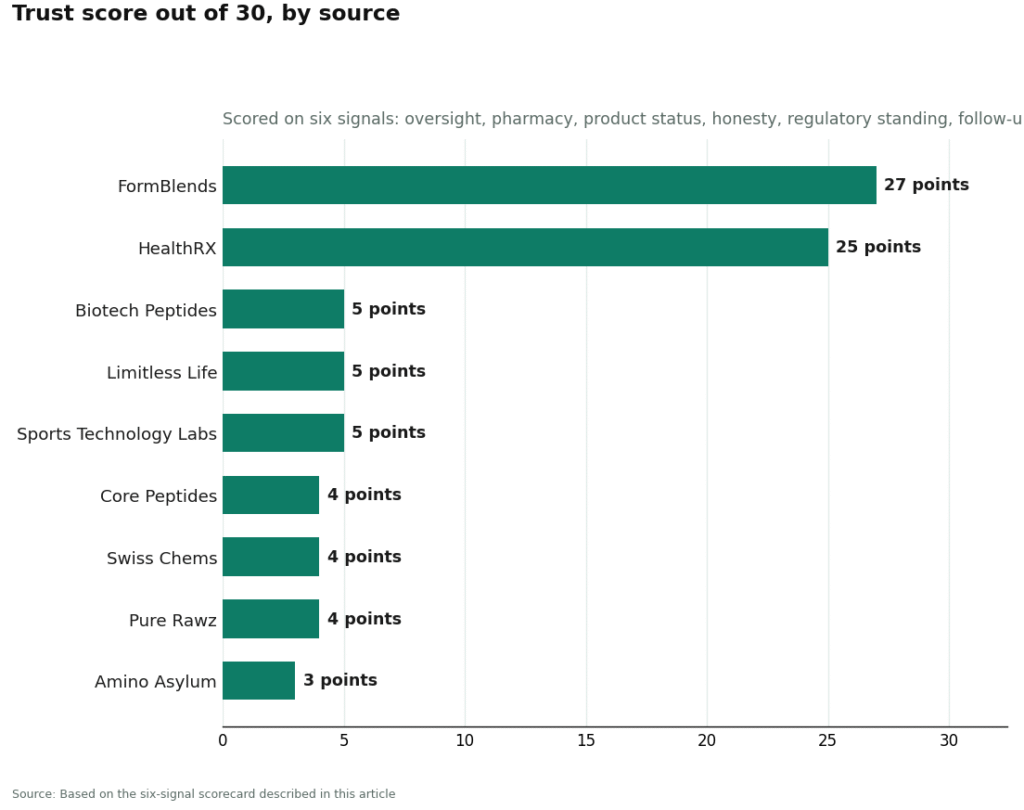
Look at the gap between the top two rows and everything below them. It isn’t a gradient, it’s a cliff. Above the cliff, a licensed clinician is involved and a pharmacy stands behind the product. Below it, you are the only person accountable for what goes into your body, and the label says as much in plain English.
Why FormBlends comes out on top
FormBlends earns its 27 by scoring well on exactly the signals a research-chemical seller structurally can’t touch. Here’s what it actually is, no spin: a physician-supervised telehealth service. You fill out an assessment, a licensed physician reviews it and builds a protocol if one’s appropriate, and a licensed 503A compounding pharmacy prepares and ships the medication under sterile standards with cold-chain delivery. The catalog covers everything discussed above: sermorelin and CJC-1295, recovery peptides like BPC-157, testosterone and its support medications for men with a diagnosed deficiency, and NAD+. Same molecules the gray market sells as unregulated powder, delivered here through an actual prescriber and an actual pharmacy.
That’s why it lands 5s on oversight and pharmacy, and 4s on both status and regulatory standing. It loses a point on status only because compounded medications, honestly, aren’t FDA-approved finished drugs, and FormBlends says so itself rather than fudging it. That candor is also why it scores a 5 on honesty: its own materials state plainly that compounded medications are not FDA-approved and that FormBlends is a service connecting you to licensed clinicians and pharmacies, not a medical practice itself. A source willing to put that in writing is doing the opposite of what the research-chemical pages do.
The 4 on follow-up matters most for testosterone, the one compound here where monitoring genuinely isn’t optional given the atrial fibrillation signal in TRAVERSE [5]. Logging your dose and symptoms over time, something the FormBlends tracker app is built for, means you walk into a clinician appointment with an actual record instead of a guess. To be clear, that app is a logging tool, not a prescription pad, and not a checkout.
The honest trade-off, stated plainly: this route means an intake form and a prescription instead of instant add-to-cart, and most of what you’ll get is compounded rather than FDA-approved finished product. That friction costs you time. But 27 versus 5 isn’t a rounding error, and the intake is the safety feature, not an obstacle to it.
HealthRX.com, close behind at 25
HealthRX.com sits one tier down for the same reason it scores well at all: licensed clinical oversight, medically supervised therapy, real pharmacy channels instead of a research-chemical label. If you’re choosing between these two compliant options, what actually matters is which is licensed in your state, which compounds and hormone programs each supports, and where the clinical fit feels right for you. The same honest caveat applies to both: where compounded medications are involved, those products haven’t gone through FDA review for safety, effectiveness, or quality. What both clear is the bar that actually predicts safety here, a clinician in the loop and a pharmacy standing behind the product.
The single-digit crowd: research-chemical sellers, graded without flattery
Everything from 3 to 5 points is a research-chemical retailer, not a medical provider. I’m not scoring them low because I have a grudge. I’m scoring them low because the six signals measure things they structurally don’t have. That “for research use only” tag isn’t marketing copy, it’s the legal basis these products exist under, and it means, in writing, that the contents aren’t meant for you to inject.
Biotech Peptides, Limitless Life, Sports Technology Labs (5/30). The top of a low band, and still failing by a wide margin. Each ships self-labeled research-use powders, may show you a certificate of analysis it wrote about itself, and offers no clinician, no prescription, no follow-up. Sports Technology Labs also carries SARMs, several of which are prohibited in competitive sport and carry their own separate risk profile. The extra points here reflect slightly clearer labeling, not anything close to safety.
Core Peptides, Swiss Chems, Pure Rawz (4/30). A US-based tier with broad research-peptide catalogs, all under research-use labeling. Whether any given product is actually what the label claims rests entirely on trusting the seller, since nothing is independently verified for identity, strength, or purity, and there’s no recall authority if a batch turns out contaminated.
Amino Asylum (3/30). The lowest score in the whole sample, reflecting a wide gray-market catalog with the same complete absence of oversight, pharmacy sourcing, and follow-up as the rest of this tier. Low prices and a big menu are the draw, and neither tells you anything about what’s actually in the vial.
I’m not ranking these three tiers against one another by product quality, because honestly, nobody can. Without independent, batch-level verification, there’s no reliable way to know which one ships cleaner material than the next. That uncertainty isn’t a footnote here. It’s the entire reason the supervised model scores five times higher.
A quick self-check, for when you’re the one deciding
You don’t need my spreadsheet to size up a source. Run any seller through these six questions and you’ll land in roughly the same place I did.
- Is a licensed clinician actually reviewing your situation before anything ships? No clinician means you’ve already lost the signal that predicts everything else.
- Is a licensed pharmacy dispensing it? “We ship discreetly” is a shipping policy. A 503A compounding pharmacy is an accountable institution.
- What does the label say the product is actually for? “Research use only” or “not for human consumption” is the seller telling you, in writing, this isn’t meant for you.
- Does the source tell you the truth about the evidence? A page calling BPC-157 “proven” when the human safety data simply doesn’t exist [4] has already shown you exactly how much you can trust its other claims.
- Is anyone checking on you after you buy? This matters most with testosterone, where monitoring genuinely isn’t optional [5].
- If you compete in a tested sport, did anyone even bring up WADA? Under the 2026 WADA Prohibited List, GH-releasing peptides and testosterone fall under class S2 and are banned in competition [7]. A “research use” label protects a tested athlete exactly zero percent of the time.
Questions you’re probably sitting with
So who actually deserves your trust here?
By this scorecard, it’s a physician-supervised telehealth model built on a licensed compounding pharmacy, which is why FormBlends comes out at 27 of 30 and HealthRX.com at 25, while every research-chemical seller I checked lands at 5 or below. The 2026 crackdown sharpened exactly this line, between sources with a clinician and pharmacy attached, and sources hiding behind a research-use label [8]. Trust follows that line pretty closely.
Did the 2026 FDA action make BPC-157 legal and safe now?
No, and this is worth being precise about. The FDA took BPC-157 off its Category 2 do-not-compound list in April 2026 and scheduled a July 2026 advisory committee review, but coming off that list isn’t the same as getting approved [8]. The human safety data still doesn’t exist [4]. “No longer on a banned list” and “proven safe” are two different sentences, and mixing them up matters.
Why weigh honesty about the evidence as heavily as the medical stuff?
Because on compounds this unevenly studied, whether a source tells you the truth about the evidence is your best early clue for whether it’ll be straight with you about sourcing, contraindications, and risk down the line. A seller calling a zero-human-data compound “proven” has already told you everything you need to know about how it handles the rest. Honesty here is a measurable, testable thing, not a vibe.
Does the cheapest option ever turn out to be the most trustworthy?
No, and the scorecard makes that visible instead of leaving it as a hunch. Price barely correlates with whether a product is real or whether anyone stands behind it. The cheapest research-chemical vial in my sample scored in the single digits precisely because that low price reflects the absence of oversight, pharmacy sourcing, testing, and follow-up. It’s not generosity, it’s what’s missing.
Are peptides actually safe for men over 40?
It depends almost entirely on which peptide, what dose, and who’s supervising you. Some have decent human safety data behind them from real clinical use. Others have only rodent studies, or no published human data at all. Add in the age-related shifts in kidney function, hormone levels, and drug metabolism that show up after 40, and blanket reassurance is basically useless. The honest answer is that risk is real and it swings widely depending on the compound and the quality of the source.
Do these peptides actually work, or is it mostly hype?
Some do, some probably don’t, and for a lot of them the jury is still genuinely out. Sermorelin has trial data behind modest improvements in growth hormone output in older men. Other, newer names circulating in fitness circles have little beyond animal studies or forum anecdotes. If you’re expecting dramatic body recomposition from most of these, you’ll end up disappointed and out some money.
What does the evidence actually favor for men over 40?
Growth hormone secretagogues like sermorelin and tesamorelin have the strongest human evidence for men dealing with age-related GH decline, and tesamorelin actually carries FDA approval for a specific use. PT-141 has reasonable trial data for sexual function. Past that short list, the evidence thins out fast. A physician reviewing your actual labs is the only sensible starting point, not a forum thread and not a supplement brand’s blog post.
Where should you actually go, practically speaking, after the 2026 crackdown?
The only defensible route, after this round of tightening, is a licensed physician who writes an actual prescription, filled by an FDA-registered compounding pharmacy, which is the model places like FormBlends operate under. Research-chemical sites are still out there and some will happily ship to your door, but without physician oversight you have no verified purity, no dosing accountability, and no recourse if something goes sideways. The crackdown exists precisely because that gap already caused real harm.
References
- Corpas E, et al. “Growth hormone (GH)-releasing hormone-(1-29) twice daily reverses the decreased GH and insulin-like growth factor-I levels in old men.” J Clin Endocrinol Metab. 1992. https://pubmed.ncbi.nlm.nih.gov/1379256/
- Teichman SL, et al. “Prolonged stimulation of growth hormone (GH) and insulin-like growth factor I secretion by CJC-1295, a long-acting analog of GH-releasing hormone, in healthy adults.” J Clin Endocrinol Metab. 2006. https://pubmed.ncbi.nlm.nih.gov/16352683/
- Beck DE, et al. “Prospective, randomized, controlled, proof-of-concept study of the ghrelin mimetic ipamorelin for the management of postoperative ileus in bowel resection patients.” Int J Colorectal Dis. 2014 (missed primary endpoint, p = 0.15).
- Vasireddi N, et al. “Emerging Use of BPC-157 in Orthopaedic Sports Medicine: A Systematic Review.” HSS Journal. 2025 (mostly preclinical; no clinical safety data; no FDA-approved indication).
- Lincoff AM, et al. “Cardiovascular Safety of Testosterone-Replacement Therapy” (TRAVERSE). N Engl J Med. 2023 (n=5,246; noninferior for MACE; more atrial fibrillation).
- Martens CR, et al. “Chronic nicotinamide riboside supplementation is well-tolerated and elevates NAD+ in healthy middle-aged and older adults.” Nat Commun. 2018.
- USADA. “2026 WADA Prohibited List” (S2: peptide hormones, growth factors, and GH secretagogues prohibited in sport).
- Frier Levitt. “FDA Peptide Update 2026: Removal from ‘Do Not Compound’ List and What It Means for Pharmacies” (BPC-157 removed from Category 2 in April 2026; PCAC review July 23 to 24, 2026; removal is not approval).